
Home Delivery of Swimming Pools with Built-in Cart
Delivering Elevators to Construction Sites: How Can You Ensure Accurate and Autonomous Unloading?
The construction of a building involves many different trades. Among the various stages of a construction project, the delivery of elevator components requires appropriate logistical planning: the parts must be delivered to the right location, at the right time, and in good condition.
It was in this context that TRED CHARIOT recently worked on a construction site for a multi-unit apartment building in Trélazé, in the Maine-et-Loire department.
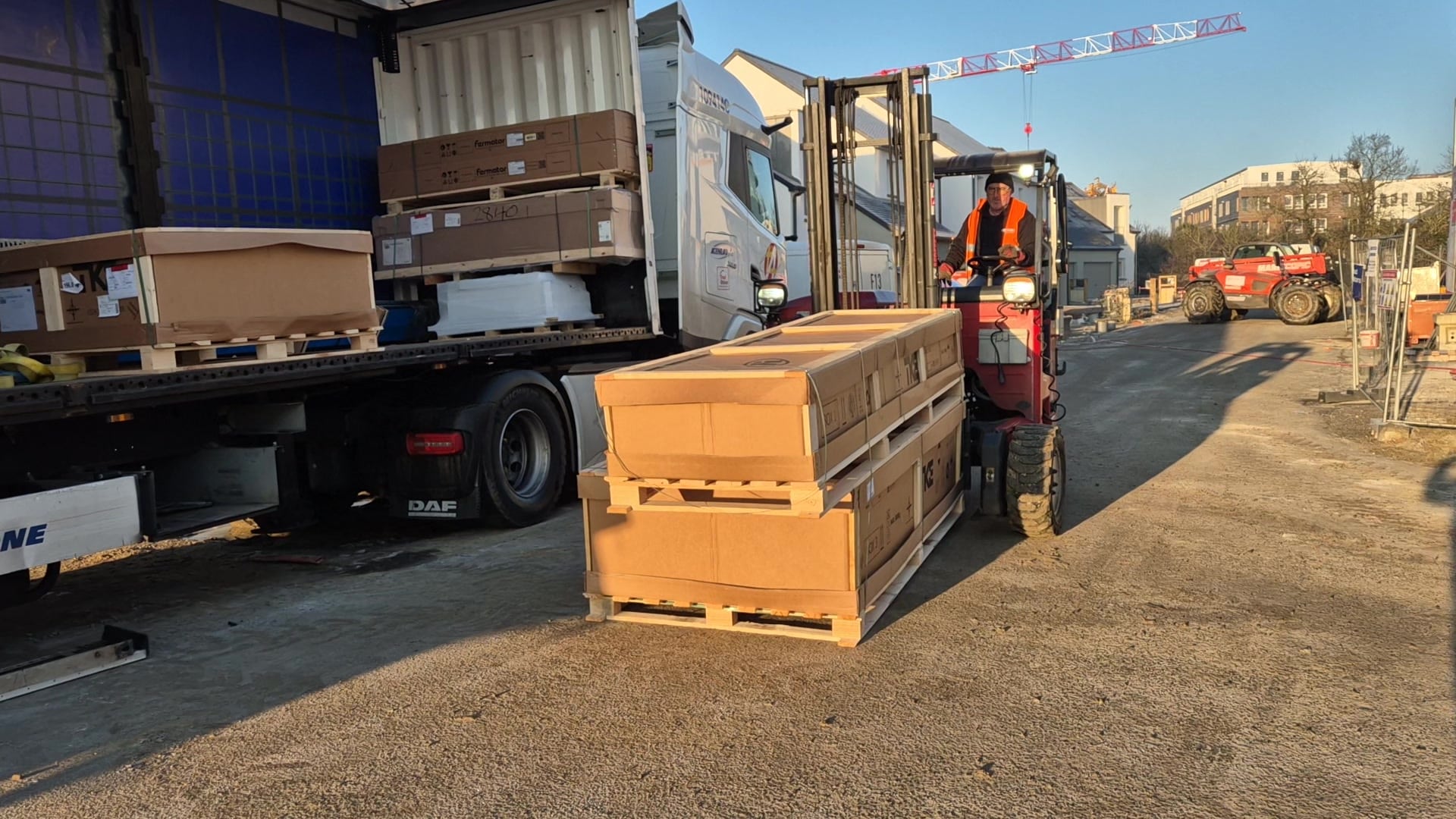
Thanks to the on-board cart, the various components could be unloaded independently and placed as close as possible to the area designated by the site manager.
This operation provides a concrete example of the benefits of using a truck-mounted forklift for deliveries to construction sites, particularly when the goods are heavy, bulky, or require special handling.
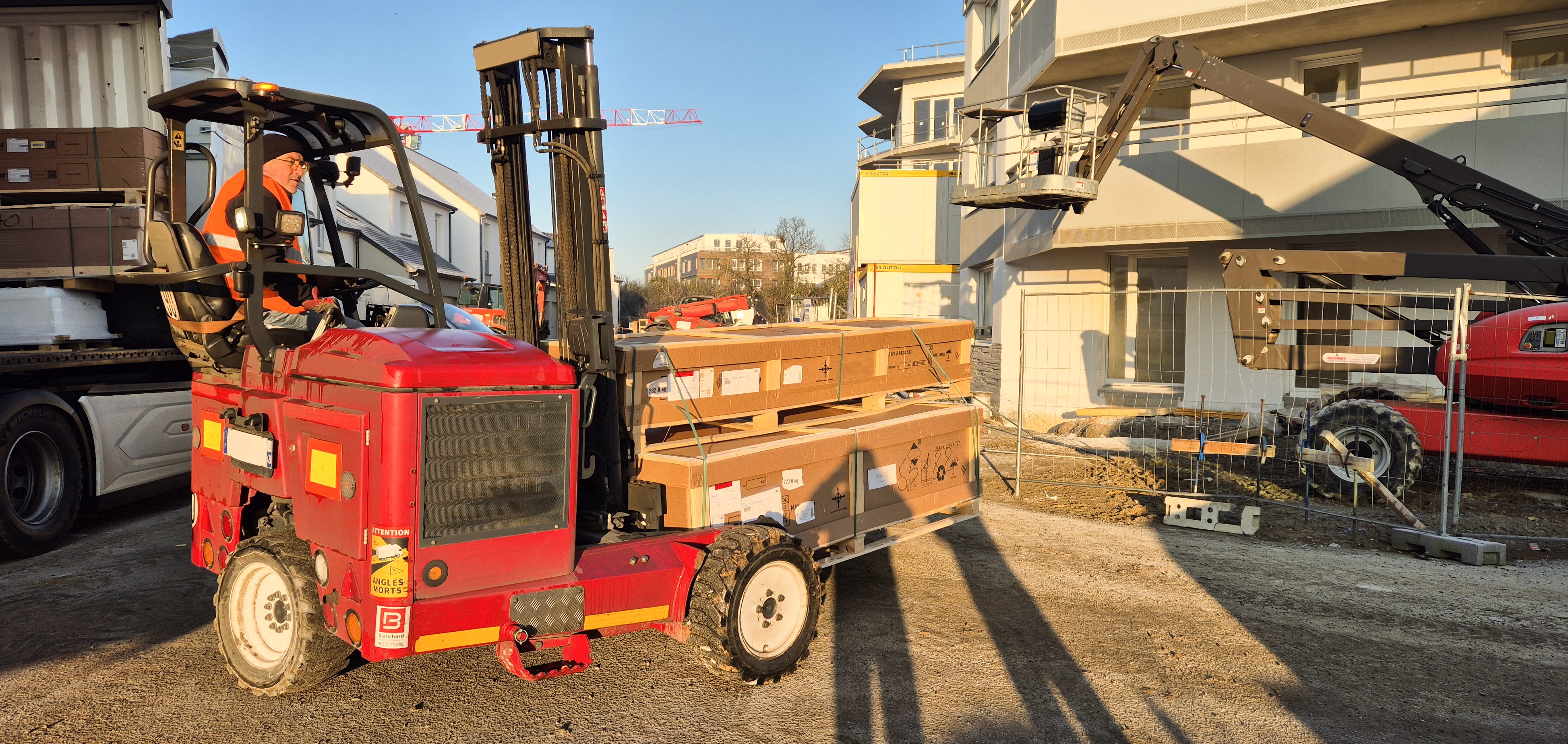
The Challenges of Delivering Elevators to a Construction Site
Deliveries to construction sites present different challenges than standard home deliveries.
The site may be under construction and changing rapidly. Space available for parking or unloading goods may be limited, and multiple companies may be working on the site at the same time.
In particular, the following factors must be taken into account: access conditions to the job site; the layout of access routes; the space available for the vehicle; the unloading area designated by the job site; the presence of other machinery or vehicles; and the schedules of the various parties involved.
These factors must be anticipated to enable the driver to perform the job under the best possible conditions.
The ability to adapt to access constraints is therefore essential to ensure the delivery of heavy or bulky goods to a construction site.
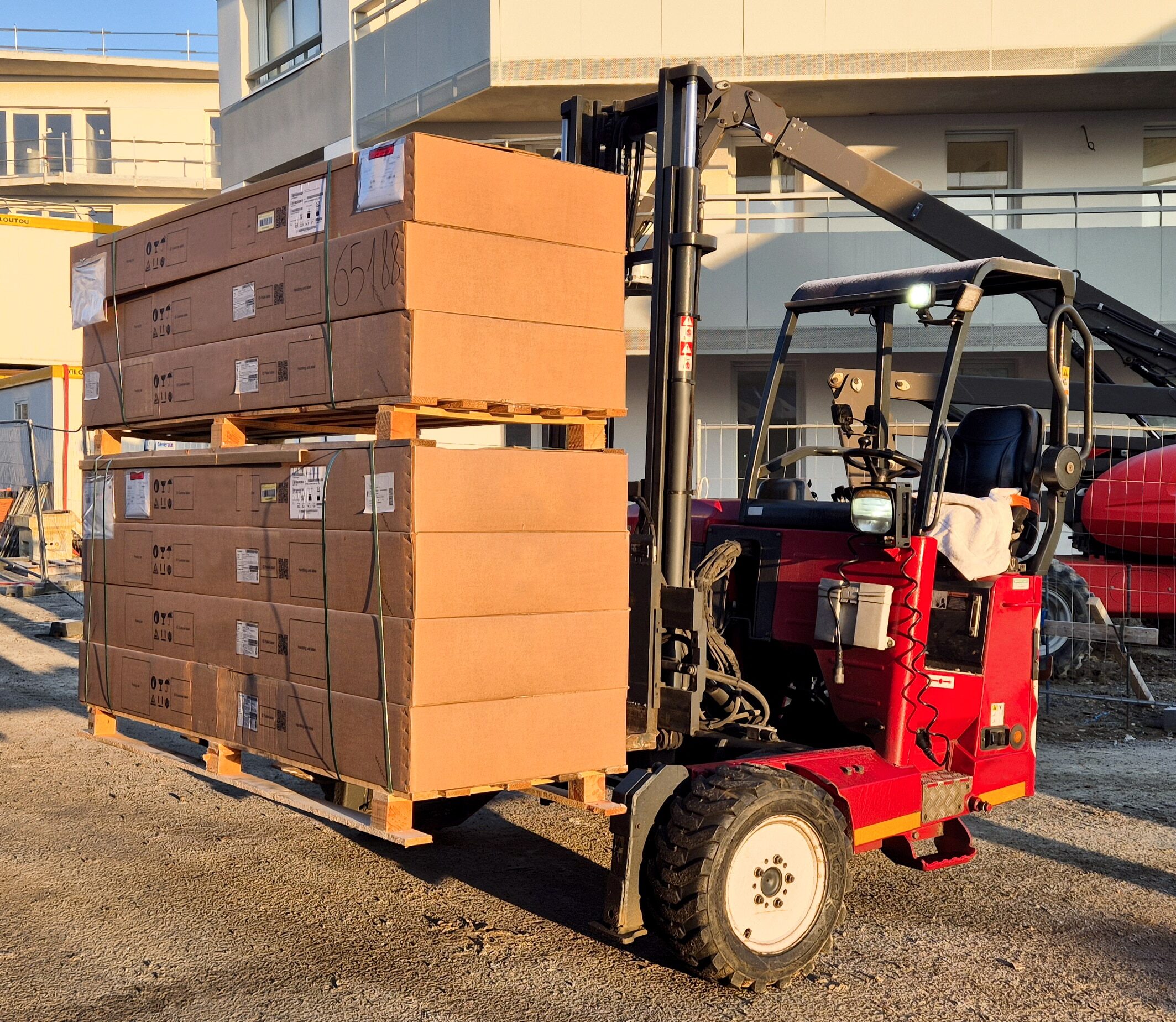
Unloading as close as possible to the assembly area
On a construction site, the location where materials are stored is important.
The various components must be stored or positioned in a manner consistent with the progress of the work and the organization of the construction site.
When access conditions permit, the on-board cart allows goods to be unloaded as close as possible to the area designated by the site manager.
This proximity can reduce the need for additional movement and handling of components prior to their installation.
For heavy or bulky items, this level of precision during unloading offers a real operational advantage for the crews on site.
A solution for manufacturers and installers
For elevator manufacturers and installers, delivery is an important step in the supply chain.
The components must be delivered to the construction site within the specified time frame and in a condition that allows the installation teams to take charge of them.
Hiring a carrier equipped with an onboard forklift provides an autonomous delivery solution that is well-suited for heavy and bulky goods.
Delivery can thus be arranged to take into account the specific constraints of each job site: access, vehicle location, unloading area, and handling conditions.
The goal is simple: to transport the equipment to the construction site and ensure it can be unloaded under the best possible conditions.
Expertise that extends to other technical equipment
The delivery of elevators is one of the operations that requires logistics tailored to the transport of heavy, bulky, or specialized products.
The on-board cart can also be used to deliver a wide range of other equipment and products, including: industrial equipment; solar panels; window and door frames; sunrooms; pool enclosures; building materials; outdoor furnishings; swimming pools; hot tubs; pergolas; andgarden sheds.
Each product has its own transportation and handling requirements. The ability to tailor delivery conditions to the characteristics of the goods and the destination is therefore an essential part of the service.
Delivery of elevators to construction sites using an on-board forklift
Elevator components are generally heavy, bulky, and require proper handling. A truck equipped with an onboard forklift allows the driver to unload the cargo independently and place it in the area designated by the construction site, when access conditions permit.
The main advantage is autonomy. No additional handling equipment is needed at the delivery location. The onboard cart also allows for adaptation to access constraints and enables precise unloading of goods.
When site layout and access conditions permit, the on-site forklift can be used to move goods closer to the drop-off area designated by the construction site. This can reduce the need for additional handling before installation.
Depending on the project, the delivery may include various components: car parts, landing doors, rails, counterweights, mechanical equipment, electrical equipment, or other items necessary for the installation of the elevator.
Yes. The onboard cart can be used for many heavy or bulky items, including industrial equipment, solar panels, sunrooms, pool enclosures, woodwork, building materials, swimming pools, spas, and pergolas.
Delivery with an onboard cart: a solution for construction sites throughout France
Delivery needs at construction sites are not limited to a specific geographic area.
Through its network, TRED CHARIOT supports manufacturers and installers with their transportation and delivery needs for heavy and bulky products throughout France.
From the delivery of elevators and technical equipment to materials and products for outdoor landscaping, transport using an onboard forklift can accommodate a wide range of delivery scenarios. The operation carried out in Trélazé is a concrete example of this: elevator components were transported to the construction site and then unloaded autonomously, as close as possible to the area designated by the site manager.